

Book 04 · The five questions
Thinking, Fast and Slow
A fast mind supplies confident answers a slow mind rarely checks.
A bat and a ball cost $1.10. The bat costs $1.00 more than the ball. How much is the ball?
Don't work it out. Just notice what arrived.
The fast hand
Ten cents
It was on the paper before you finished the question, and it is wrong. Nobody who answers ten cents lacks the arithmetic. They lack a reason to check. An answer arrived, it fit the wording, no alarm went off, and the search stopped.
Confidence is a feeling produced by coherence and ease, not an estimate of the chance of being right.
The slow hand
Five cents
It rules a line, does the sum, and arrives about two seconds late. A ten-cent ball makes the pair a dollar twenty. In the results the book reports, more than half the students at Harvard, MIT and Princeton gave the first answer anyway.
Watch what the eraser leaves behind. Checking changes the answer on the page. It does not remove the answer that came first.
The proof
The line you cannot un-see
Two shafts of identical length. The one wearing its fins outward looks longer, every time. Kahneman uses the Müller-Lyer illusion because the ruler settles the question and changes nothing: you can learn the rule and give the right answer for the rest of your life, and one line will still look longer.
Naming a bias lets you correct the answer. It does not make the intuition go away.
Five questions
What this book answers
They run in the order the book argues them, from the first premise to what to do about it. Each one is about four minutes to read, or to hear with the words lit as they are spoken.
- When a split-second judgment feels effortless and coherent, why is that confidence often evidence of fluency rather than truth, and under what limits of attention should education, work, or technology force a second look?The answer that arrives before you askWhy a thought that feels obviously right is often just a thought that came easily, and when a school, an office or an app should make you look twice.
- When data are scarce, noisy, or emotionally vivid, why do stories, stereotypes, and recent examples defeat probability, and how should science, medicine, finance, and public policy decide when intuition, experts, or models deserve trust?Right about everything except the causeWhy a good story beats a base rate every time, and how to tell when a doctor, a fund manager or a formula has actually earned your trust.
- If two choices have identical consequences, why can ownership, wording, and whether an outcome feels like a gain or loss reverse what people choose, and how should markets, law, and product design present risk without exploiting that instability?Same money, opposite choicesJack and Jill both have five million. One is elated and one is miserable, and that gap explains why wording, ownership and a default can flip a decision.
- When the life we remember conflicts with the moments we actually lived, which record should define well-being, and how should personal goals, economics, and health policy weigh intensity, duration, memory, and adaptation?The self that keeps the diary did not live the dayEighty percent of people chose to repeat the more painful experience. What that says about holidays, colonoscopies, money and the life you think you are having.
- If predictable errors are built into ordinary judgment, when should a person or institution redesign the decision rather than demand more willpower, and how can checklists, defaults, formulas, and dissent improve outcomes without taking away agency?Stop trying harder and change the roomKahneman studied bias for decades and admits it did not cure him. His answer is to redesign the decision, not the decider.
What to do about it
Change the room, not the decider
Kahneman studied this for decades and says it did not cure him. His answer is to build the second look into the situation instead of the person: a base rate, a comparison case, a rule, put where the decision actually happens.
Buy the bookStart with question one
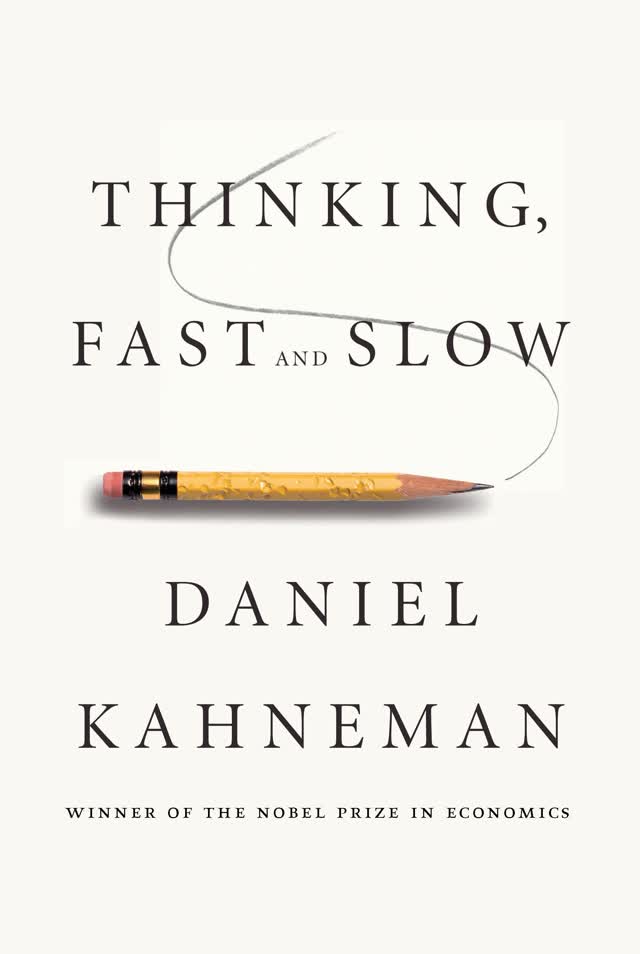
Published by Farrar, Straus and Giroux. Cover shown to identify the book. Daniel Kahneman drawn as an editorial caricature.