
Hours spent01Copies out0001
Book 02 · the five questions
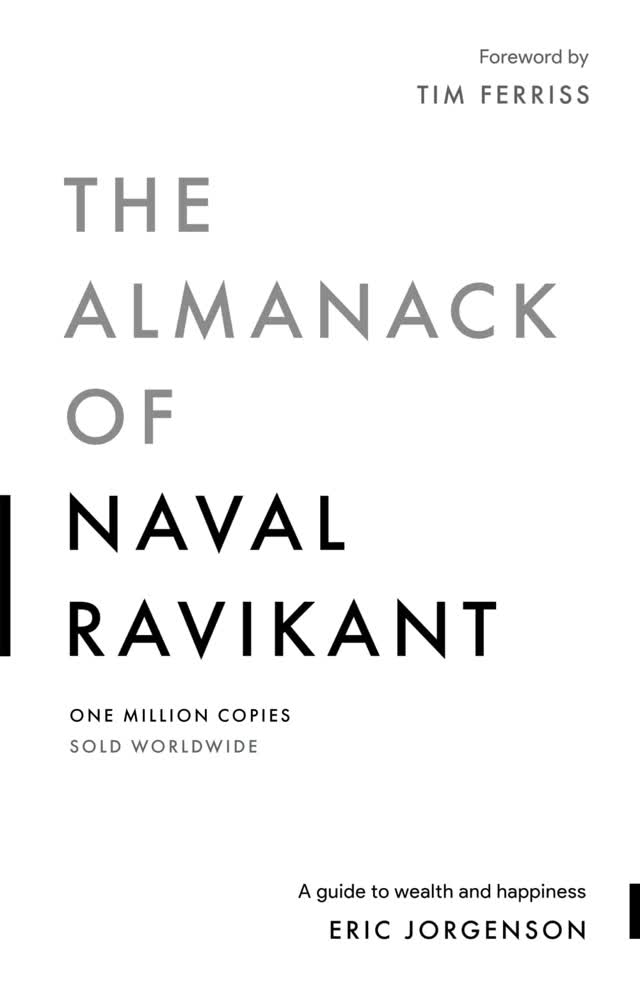
The Almanack of Naval Ravikant
Wealth comes from ownership and leverage, not from selling hours.
One book. One hour of a life, spent once. Everything below it on this page is a copy of that hour that cost almost nothing to make.
The first copy is expensive. Only the second one is cheap.
A talk reaches the people in the hall. Eric Jorgenson gathered Naval’s talks and posts into this book, and it reached readers who were never there. That is what Naval means by leverage of the third kind: labour needs people who agree to follow you, capital multiplies your bad decisions as faithfully as your good ones, but code and media need nobody’s permission and the next copy costs almost nothing.
More effort raises what you earn and leaves your freedom exactly where it was.
A doctor sells an hour for far more than a restaurant worker does, and both stop being paid the moment they stop. A wage buys time. Equity is a slice of the thing being built, and it keeps working while you sleep. Only the second one detaches the reward from your presence, which is why the ceiling moves for one of them and not the other.
What the hour left behind
Five questions the book answers, in the order it argues them. Each one is a short piece you can read in about four minutes.
- Why can working harder for wages still fail to produce scalable freedom, and how can ethical value, differentiated knowledge, ownership, and leverage build wealth without depending on luck?The hour you cannot sell twiceWorking harder raises your income and leaves your freedom exactly where it was. Naval's way out runs through ownership, leverage and a very long clock.
- When leverage magnifies every choice, how can you move faster by slowing down, using first principles, incentive analysis, probability, and intellectual honesty to choose direction before speed?Ten points of judgment, one hundred million dollarsWhen leverage sits behind a choice, being a little more right is worth more than being a lot more busy. Naval's case for slowing down exactly once.
- If achievement satisfies desire only briefly, how can ambition remain useful without making peace depend on status, comparison, or a future outcome?A contract to be unhappy until it arrivesNaval spent his evenings reading about a car he already knew would barely change his life. What the wanting taught him about ambition, envy and peace.
- In environments engineered for comfort and distraction, which systems make health, attention, and behavior compound without relying on willpower?Willpower is badly outnumberedEntire industries are testing what holds your attention one more minute. Naval's answer: let the calendar, the room and the company carry some of the weight.
- If meaning is created rather than discovered and life is finite, which tested values, relationships, and learning practices let you act urgently while playing long-term games?Three answers that refuse to agreeNaval has three answers to what life means and does not make them match. What he builds on: tested values, equal partners and a library that never closed.
The hour you could not sell twice was always the point.
Retirement, for Naval, arrives at no particular age or figure. It is the point where you stop sacrificing the present against your will. All of the leverage exists to buy back the only thing that was ever scarce, and it was never the money.
Buy the bookStart with question one
The Almanack of Naval Ravikant, compiled by Eric Jorgenson, published by Magrathea Publishing. The cover is shown to identify the book. Naval Ravikant is drawn as an editorial caricature.