Book 03
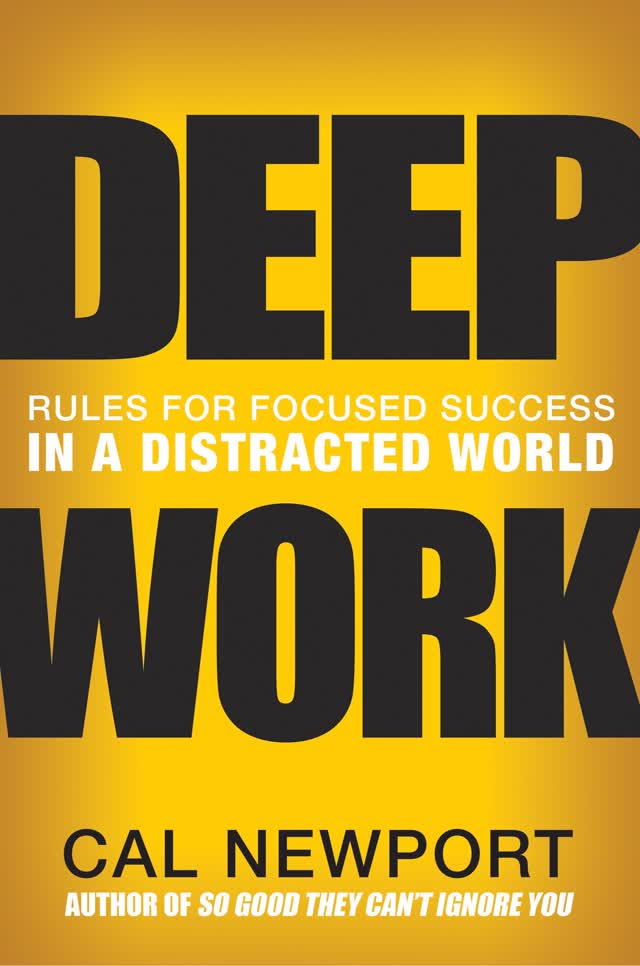
Deep Work
Cal Newport
Undistracted concentration is rare, valuable, and can be deliberately designed.
Five questions this book answers, each written as a short piece you can read in about four minutes, or listen to with the words lit as they are spoken.
The price
Your day is built against the thing it pays for
Two abilities decide what a knowledge worker is worth. Learning hard things quickly, and producing at a high level once you have. Both run on attention held in one place long enough to hurt.
Offices are built the other way round. Open floors, instant messaging, a reply expected inside the hour. None of it is stupid: every piece has an obvious benefit, and what it costs cannot be counted. So the cost goes uncounted, and the habit survives every review it is put through.
Newport's name for that cost is attention residue. Glance away for one minute at something unresolved and part of it comes back with you, and stays, and quietly lowers the ceiling on everything you do for the rest of the afternoon.
Depth
Depth is built, not summoned
Willpower is finite and mostly missing at the moment you need it, so concentration cannot be a decision you make each morning. It has to be designed. A time. A place. A rule about what is allowed into the room. An end you do not negotiate with.
The claim underneath the advice is the stranger one. The work does not become more interesting when you concentrate on it. Everything else becomes quieter, and then you can finally see what was in front of you the whole time.
This page works the same way. It settles when you do.
Four hours
Four good hours
Even people who have trained at this for years top out at around four hours of genuinely intense thought a day. The rest of the day is not wasted. It is just not that.
Which leaves one question worth arguing about: of everything asking for your attention right now, what has earned those four hours?
The five questions
- Why does an economy that rewards rapid learning and exceptional output build workplaces around constant interruption, and when does resisting that pattern create an advantage rather than undermine coordination?Your office is built to break the thing it pays forThe economy rewards people who learn hard things fast. Workplaces reward people who answer fast. Cal Newport on why, and when to stop playing along.
- How can narrowing attention, not finding a more glamorous job, turn ordinary demanding work into a source of absorption and meaning?What a blacksmith knows about your jobYou do not need a more glamorous job to find meaning in work. Cal Newport's case that attention, difficulty and craft do the work a better title cannot.
- If willpower is unreliable, cognitive intensity is capped, and collaboration both sparks and fractures insight, what mix of schedule, space, ritual, measurement, and recovery makes exceptional concentration repeatable?Four good hours, and how to protect themWillpower runs out and the brain caps intense thought at a few hours a day. Cal Newport's system for making deep focus happen anyway, on a schedule.
- How can a mind conditioned by instant stimulation relearn boredom, hold one problem, and intensify focus without abandoning technology?Your attention is being trained right now, in a queueA digital detox does not fix a distracted mind. Cal Newport's training plan for rebuilding focus while keeping the tools you actually need.
- When every tool, message, meeting, and routine duty offers some benefit, what evidence should decide which deserve scarce attention, and how can the rest be compressed without damaging relationships, results, or leisure?The farmer who sold his hay balerEverything has some benefit, which is why 'it might help' decides nothing. Cal Newport's test for what deserves your attention, and how to shrink the rest.
Shutdown
Shutdown complete
The ritual is small and slightly embarrassing. At the end of the day you walk every open loop, write a credible next step against anything unfinished, and then say a fixed phrase out loud that means the day is closed.
It works because an unfinished task keeps asking to be finished until it believes there is a plan. Rest is not the reward for the work. It is one of the conditions for it.
Start with question oneBuy the book
Cover shown to identify the book under discussion. Cal Newport drawn as an editorial caricature.